WEDDINGS ARE LOUD, MARRIAGES ARE SILENT
In India, marriage is more than a personal choice—it is a cultural milestone, a family festival, and a carefully choreographed spectacle. The rituals are ancient, the celebrations enormous, and the expectations sky-high. Priests chant mantras, designers create matching outfits, drones hover to capture cinematic moments, and every gesture is broadcast across social media. It seems sacred. It feels important. But beneath all this glitter, one question quietly lingers:
Are we truly prepared for what marriage means?
Among the many mantras recited during Hindu wed-dings, one stands out for its simplicity and seriousness: “Shubh Mangalam Savd-haan” – This is auspicious. This is holy. Be alert.
And yet, that alertness is rarely present. We prepare for the wedding, not for the marriage. We focus on lighting and guest lists, not on communication and compatibility. The sacred Panigrahan Sanskar where the groom holds the bride’s hand and vows to walk with her in dharma and joy-is often treated as a backdrop for photos. The Saptapadi, the seven steps around the fire, is interrupted for camera angles. Couples vow to stay together for seven lifetimes without fully knowing how to be together for seven days.
The ritual ends. The guests leave. The music fades. And two people- often strangers in arranged marriages-be-gin a life they may be emotionally unprepared for.
The horrifying Raja Raghuvanshi case in May 2025 exemplifies the extreme darkness of this disconnect. A newlywed business-man, allegedly murdered by his wife during their honeymoon, left the nation stunned. The marriage had been solemnized with fire and mantras. Yet, behind the symbols lay betrayal, violence, and possibly a premeditated plot. Although exceptional in its brutality, the case raises a broader truth: when sacred rituals are used as social camouflage, the consequences can be devastating.
But beyond this horror lies a quieter tragedy that unfolds daily: couples who live together yet remain emotionally distant from each other. They dine at the same table, raise children, attend functions, and uphold appearances. But they are not partners in any meaningful sense. The connection is lost. What remains is form without feeling, routine without relationship.
India’s divorce rate is low, but that figure is mislead-ing. It does not account for emotional divorces, the marriages that exist solely for society’s comfort. Many couples remain together not out of love or hope, but out of fear-fear of family dishonour, of gossip, of being judged, or simply the fear of starting anew.
Young Indians today have observed this silent strain within their families. They’ve seen parents, aunts, and uncles living stifled, resigned lives, married more to tradition than to each other. Many are determined not to repeat that mistake.
That’s one reason why live-in relationships are gaining popularity-not out of rebellion, but from a genuine desire to avoid trauma. For this generation, a live-in situation provides breathing room, time to explore compatibility, and a way to test commitment without the legal and emotional burdens of marriage. In metropolitan areas, this is already a reality even if most families remain unaware or unwilling to acknowledge it.
And yet, under pressure, many young people still agree to traditional marriages, often arranged hastily and based on superficial compatibility. Trouble usually begins within weeks. Dowry expectations – though technically out-lawed-remain quietly present. Families continue to see marriage as a social invest-ment. For some women, the man they marry turns out to be nothing like the one they imagined. He may be emotionally unavailable, immature, or controlling. In moments of vulnerability, when someone outside the marriage offers attention or comfort, they may find themselves trapped in unhealthy or exploitative relationships.
Marriage is not just about living together; it’s about being together. It is about sharing emotions, responsibilities, time, space, and even silence. It involves physical intimacy, not as a mechanical act, but as a space of care, connection, and mutual trust. But these things are not taught. No one explains that genuine partnership requires effort, empathy, and evolution.
Recently, in urban spaces, another contradiction is emerging. Social media and elite society often glamorize relationships without commitment. Influencers and celebrities casually switch partners, flaunt open affairs, and normalize multiple relationships. They are still admired, followed, and celebrated. The rules are different for them. If a celebrity breaks a marriage, they’re “finding them-selves.” But if a middle-class woman chooses her partner, she’s labelled “rebellious.” This double standard is one of the cruelest hypocrisies of modern Indian society, where power shields the privileged, and morality is weaponized against the ordinary.
The pressure to look perfect, to be seen as in love, to appear settled, and to seem successful has led to disturbing patterns. In some urban circles, women enter transactional relationships with older men, sometimes called “sugar daddies,” merely to afford a lifestyle that social media deems desirable. This is not mere materialism; it is the crushing weight of comparison culture, where identity is shaped more by Instagram than by introspection.
And yet, despite all this chaos, the idea of sacred union still holds power when approached with maturity and conviction.
Consider the famous Indian mythological story of Savitri and Satyavan. Savitri knew Satyavan was destined to die young, yet she married him with full awareness. When Yama, the god of death, came to take him, she followed —not with tears, but with wisdom. She reasoned with death, stood by her vow, and brought her husband back through the strength of her clarity and love. That was marriage as a choice, not pressure conviction, not compliance.
Compare that with many modern weddings, where couples recite “Tava hastam mayi dhattam” (I hold your hand in sacred union), yet often do not understand the meaning of holding someone’s hand through failure, illness, or fear. We are perfecting the wedding photo. But we are forgetting the marriage that follows.
What, then, must be done? The answer is not to reject marriage, but to redefine how we prepare for it.
Emotional education must be as important as academic success. We must normalize pre-marital counseling and teach young people about values, mental health, and financial planning. Priests must explain mantras in everyday language. Savdbaan be alert should not be a ritual soundbite but a heartfelt reminder.
Indian law is also evolving. In the landmark Lata Singh v. State of Uttar Pradesh (2006) case, the Supreme Court upheld the right of consenting adults to marry whom they choose, saying: “This is a free and democratic country, and once a person becomes a major; they can marry whomever they like. If the par-ents… do not approve of an inter-caste or inter-religious marriage, the maximum they can do is to cut off social relations. They cannot give threats or commit or instigate acts of violence.”
Yet even today, freedom remains fragmented. In cities, some women misuse laws, causing family rifts and false cases. In villages, most women are still denied access to justice or even basic consent. Marriage remains a male-dominated institution, where control masquerades as protection.
India today is split between too much freedom and too little. Between curated Instagram weddings and collapsed homes. Between ancestral rituals and absent understanding.
But there is hope-if we listen.
Let weddings remain beautiful. Let traditions continue but let them be rooted in truth. Let “Shubh Mangalam Savdhaan” not just be an ancient chant, but a call to be emotionally present, socially honest, and spiritually awake.
Alert to the love we share. Alert to the silence we conceal. Alert to the lite we promise-not just for a day, but for a lifetime.
Marriage is not about being seen; it’s about being understood. Not by the crowd, but by the one hand you choose to hold.
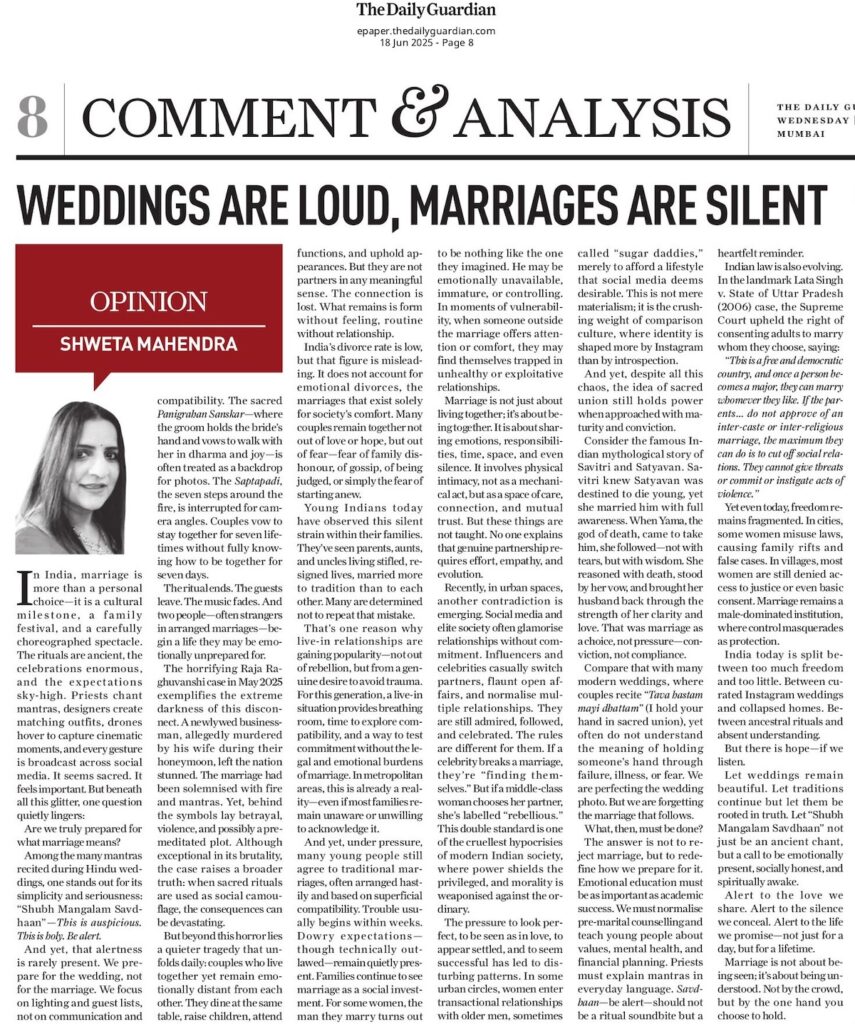
Also view this article in The Daily Guardian, Mumbai 18 June, 2025, Page 8